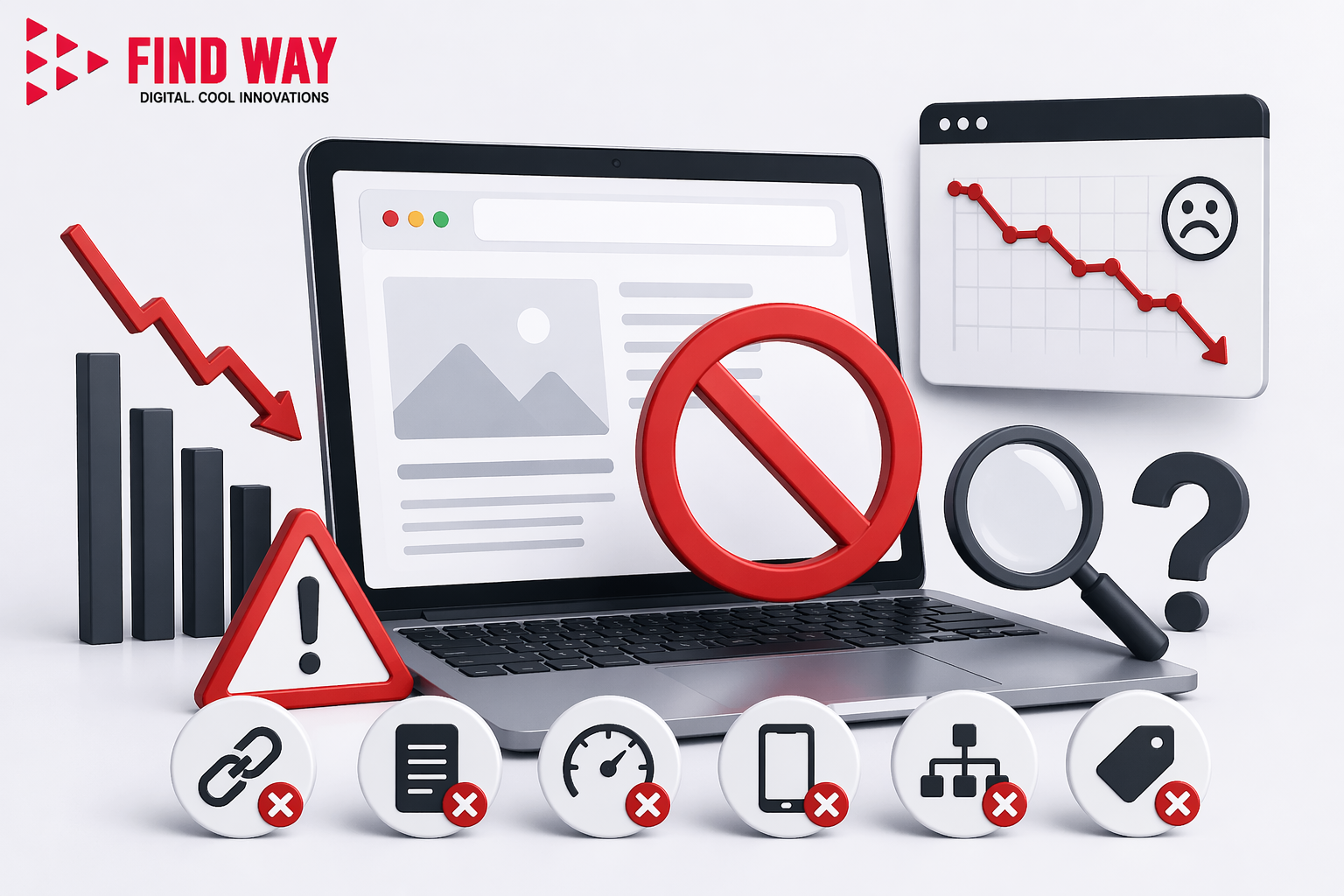
Website Not Getting Traffic? 10 SEO Mistakes You Must Fix in 2026
Still publishing content regularly — and watching the traffic flatline?
You're not alone. And the fix isn't publishing more. It's publishing smarter.
SEO in 2026 has fundamentally shifted. Google, AI Overviews, and voice search now reward content that answers intent, demonstrates authority, and loads fast on every device. If your website isn't getting traffic, you're likely making one (or more) of the 10 mistakes below.
Let's diagnose and fix them — one by one.
1. You're Targeting Keywords Instead of Search Intent
Why this kills your traffic: Search engines no longer match keywords — they decode why someone is searching. A page stuffed with the right words but solving the wrong problem will not rank.
The mistake: Writing content around keywords without addressing the user's actual goal.
The fix:
-
Identify the intent behind every target keyword (informational, navigational, commercial, transactional)
-
Start by answering the main question directly within the first 100 words to immediately address user intent.
-
Structure your headings around questions your audience actually asks — like "How do I increase website traffic fast?"
Pro tip: Use Google's "People Also Ask" and "Related Searches" to uncover real user intent, not just volume data.
2. Your Content Isn't Built to Be Scanned
Why it matters: Studies consistently show users scan content before committing to reading it. AI systems do the same — they extract structure, not just keywords.
The mistake: Publishing dense paragraphs with no visual hierarchy.
The fix:
-
Keep paragraphs to 2–3 lines maximum
-
Use descriptive H2s and H3s that work as standalone answers
-
Bold key phrases, not random words
-
Add a TL;DR or key takeaway box at the top of long posts
3. You're Ignoring AEO — Answer Engine Optimization
Why it matters in 2026: AI Overviews (Google SGE), ChatGPT search, and Perplexity AI are now answering questions instead of showing links. If your content isn't structured to be cited, you're invisible to an entire channel.
The mistake: Writing content that explains, but never directly answers.
The fix:
-
Place a concise, direct answer immediately after each H2
-
Add an FAQ section at the end of every post (like this one)
-
Use plain language — no jargon in your definitions
-
Format key answers as 40–60 word summaries that AI can lift cleanly
4. Slow Page Speed Is Silently Killing Your Rankings
Why it matters: Google's Core Web Vitals directly influence rankings. A page that loads in 4 seconds loses significant organic and paid traffic — and in 2026, the threshold for "acceptable" has only gotten tighter.
The mistake: Launching content on unoptimized infrastructure and never measuring load performance.
The fix:
-
Compress and serve images in WebP or AVIF format
-
Move to a host with strong LCP (Largest Contentful Paint) benchmarks
-
Defer non-critical JavaScript and eliminate render-blocking resources
-
Run monthly checks with Google PageSpeed Insights or GTmetrix
5. You're Not Optimizing for Mobile — You're Just Responsive
Why it matters: There's a difference between a site that works on mobile and one that's built for mobile. Google now prioritizes the mobile version of your website when indexing content.
The mistake: Treating mobile optimization as a checkbox, not a primary design decision.
The fix:
-
Check each page on an actual device instead of relying only on Chrome DevTools.
-
Ensure tap targets are large enough and text doesn't require zooming
-
Prioritize above-the-fold speed on mobile specifically
-
Simplify navigation for thumb-based interaction
6. You're Missing Local SEO and GEO Targeting
Why it matters: Search results in 2026 are hyper-personalized by location. A business in Chennai and one in Chennai show different results for the same query. If you're not optimized for your geography, you're losing to competitors who are.
The mistake: Publishing generic, location-agnostic content when your audience is local.
The fix:
-
Include city, region, or neighborhood keywords naturally within your content and metadata
-
Keep your Google Business Profile fully updated with categories, hours, and posts
-
Build dedicated local landing pages for each service area you target
-
Earn local backlinks from regional directories, news outlets, and partner sites
Understanding how to implement GEO strategies without over-engineering them is a common challenge — especially for businesses expanding into new regions. Focusing on hyper-local relevance rather than broad geographic targeting tends to produce faster results.
7. You're Publishing Without Topical Authority
Why it matters: Google's Helpful Content system rewards depth and expertise. If your blog covers 20 unrelated topics, it signals that you're a generalist — and generalists don't rank for competitive queries.
The mistake: Publishing whatever seems popular without building a clear niche.
The fix:
-
Define your site's core topic and stick to it
-
Build topic clusters: one pillar page supported by 5–10 supporting articles
-
Interlink aggressively within clusters to pass authority and signal depth
-
Only expand your niche after dominating your core subject
8. You're Letting Your Content Go Stale
Why it matters: Content decay is real. Pages that ranked well in 2023 can lose 30–50% of their traffic by 2026 if never updated. Google favors freshness, especially in competitive niches.
The mistake: Adopting a "publish and forget" content strategy.
The fix:
-
Audit your top 20 pages every quarter
-
Update statistics, examples, screenshots, and outdated references
-
Add new sections reflecting current trends or questions
-
Change the published/updated date only after making meaningful updates
9. Technical SEO Issues Are Blocking Your Rankings
Why it matters: Brilliant content on a broken site is invisible content. Crawl errors, missing sitemaps, and indexing issues prevent search engines from even seeing your work.
The mistake: Focusing entirely on content while ignoring the technical foundation.
The fix:
-
Submit and maintain an up-to-date XML sitemap via Google Search Console
-
Fix all crawl errors and broken internal links
-
Ensure no important pages are accidentally marked noindex
-
Implement schema markup (Article, FAQ, HowTo) to help search engines understand your content's structure
10. You're Making Content Decisions Without Data
Why it matters: Gut instinct doesn't scale. The SEO strategies that work in 2026 are built on continuous feedback loops — publish, measure, adjust, repeat.
The mistake: Treating SEO as a set-and-forget tactic rather than an ongoing process.
The fix:
-
Install Google Search Console and Google Analytics 4 right from the start.
-
Track keyword rankings, CTR, and bounce rate monthly
-
Identify your top 5 performing pages and double down on what makes them work
-
Use data to kill underperforming content, not just create new content
Quick Recap: Why Your Website Isn't Getting Traffic
If your traffic is stagnant, you're likely dealing with one or more of these:
-
Targeting keywords, not intent
-
Ignoring AI answer engines (AEO)
-
Skipping local SEO and GEO targeting
-
Publishing unstructured, hard-to-scan content
-
Poor page speed and mobile experience
-
No topical authority or content clusters
-
Outdated content with no refresh strategy
-
Unresolved technical SEO issues
-
No performance tracking or data-driven adjustments
The good news? Every single one of these is fixable.
FAQs: SEO Traffic in 2026
What is the fastest way to increase website traffic in 2026?
The fastest path is a combination of intent-matched content, AEO formatting (direct answers + FAQ sections), fixing Core Web Vitals, and refreshing your highest-potential existing pages. New content takes time; optimizing what you already have delivers results faster.
Why is my website not getting traffic even though I'm doing SEO?
The most common culprits are misaligned search intent, poor content structure, technical crawl issues, or a lack of topical depth. SEO effort without strategic direction produces very little return.
Does SEO still work in 2026?
Absolutely — but SEO in 2026 means optimizing across three dimensions: traditional search (SEO), AI-generated answers (AEO), and location-based results (GEO). Focusing on only one of these leaves significant traffic on the table.
How important is local SEO in 2026?
Critical — especially for service businesses and brick-and-mortar operations. With AI-personalized search results, location relevance can determine whether you appear at all for a significant portion of your target audience.
How frequently should you refresh your website content?
High-traffic and high-competition pages should be reviewed every 3 months. Lower-traffic pages can be updated every 6 months. Prioritize updates based on traffic decline, ranking drops, or outdated information — not just a fixed schedule.
Final Word
If your website isn't getting traffic, the problem isn't your effort — it's the strategy behind it.
SEO in 2026 rewards websites that are fast, clear, authoritative, and structured for both humans and AI. When you align your content with how people actually search — and how AI systems retrieve answers — traffic stops being a struggle and starts being a result.
Start with the mistakes that feel most familiar. Fix one. Then the next. Momentum builds faster than you think.
And if you'd rather not figure it all out alone — that's exactly where a team like Findway Digital comes in. With over a decade of hands-on experience in SEO, web development, and digital marketing, they help businesses cut through the noise and build visibility that actually converts. Whether you're starting from scratch or fixing what's broken, having the right partner makes the process faster and the results more predictable.
Because in 2026, the businesses winning online aren't just working harder — they're working with the right strategy, and the right people behind it.