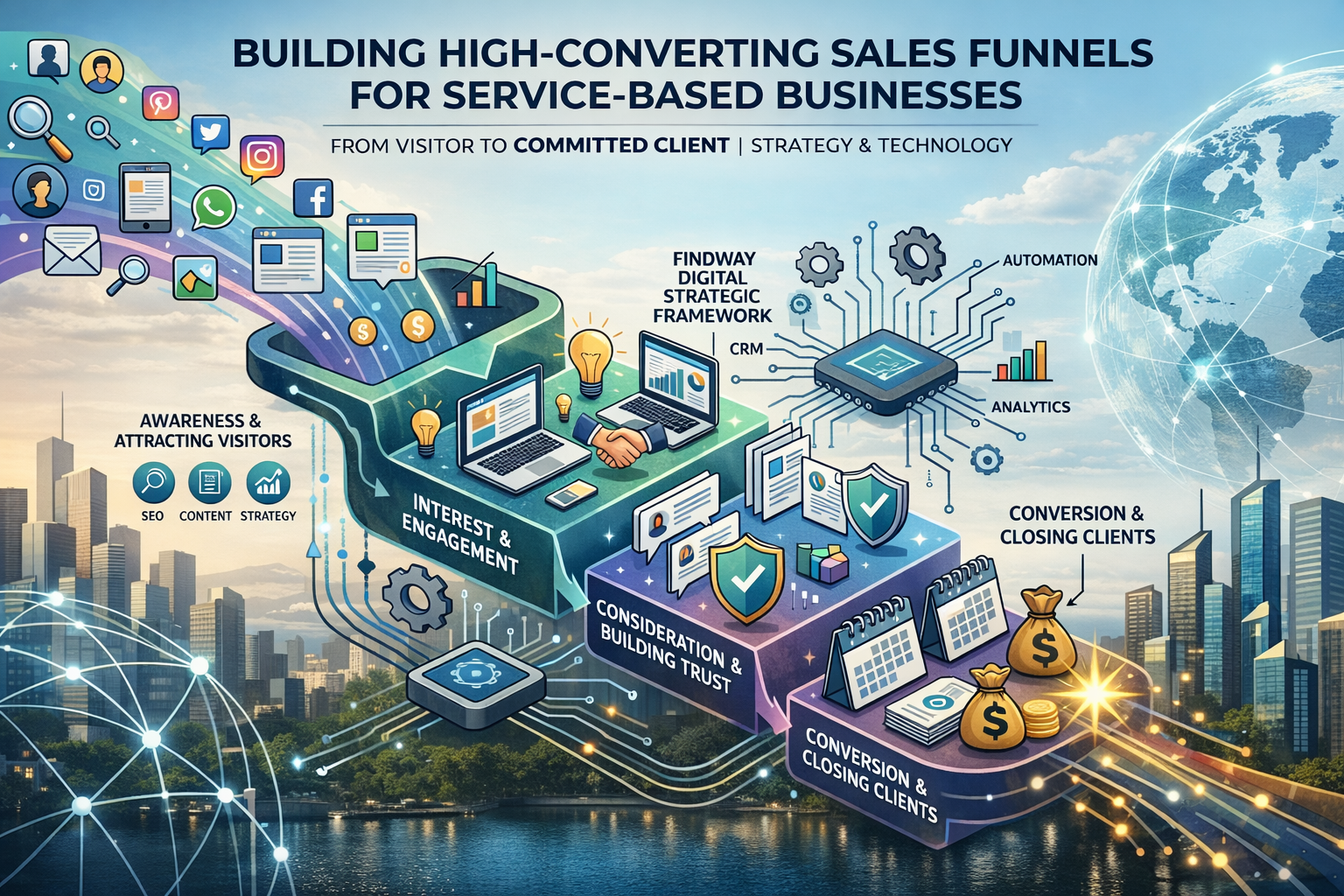
How to Build a High-Converting Sales Funnel for Service-Based Businesses
What Is a Sales Funnel for Service-Based Businesses?
A sales funnel is a structured journey that turns casual visitors into committed clients. It maps how potential clients discover your business, engage with your content, evaluate your expertise, and ultimately decide to work with you.
Unlike product-based funnels, service funnels focus heavily on trust, clarity, and relationship-building. Service investments often involve higher decision-making complexity, which makes credibility and communication essential.
At Findway Digital, we’ve observed that businesses implementing structured funnel strategies move from unpredictable lead flow to consistent, measurable client acquisition systems.
Why Sales Funnels Matter for Service Businesses
Service-based businesses including consultants, agencies, IT firms, designers, and professional service providers depend on qualified leads and meaningful conversations.
A well-designed sales funnel:
- Guides prospects logically through decision stages
- Reduces hesitation around service investments
- Aligns marketing with real buyer behaviour
- Improves conversion predictability
- Enables performance tracking and optimization
Instead of relying solely on referrals or inconsistent campaigns, a funnel creates a scalable growth framework.
The Core Stages of a High-Converting Funnel
1. Awareness (Attracting the Right Audience)
This stage focuses on visibility. The goal is to reach the right audience, not just more traffic.
Effective strategies include:
- SEO-driven blog content
- High-intent keyword targeting
- Educational social media content
- Webinars and downloadable resources
- Paid campaigns with precise audience targeting
Understanding search intent and audience behaviour ensures your visibility efforts attract relevant prospects globally and across regional markets.
2. Interest (Building Engagement Through Value)
Once visitors discover your business, the next step is nurturing engagement.
This can include:
- In-depth educational articles
- Industry reports and insights
- Practical guides and frameworks
- Downloadable templates and checklists
Providing value before asking for commitment builds authority and establishes long-term trust.
3. Consideration (Demonstrating Credibility)
At this stage, prospects compare solutions. They want reassurance that your process works.
Effective content here includes:
- Case studies
- Client testimonials
- Success metrics
- Transparent process explanations
- Detailed service comparisons
Clear proof and structured communication reduce uncertainty and position your service as a reliable choice.
4. Conversion (Encouraging Meaningful Action)
For service businesses, conversion usually means initiating a conversation — scheduling a consultation, requesting a proposal, or starting a discovery call.
To improve conversions:
- Make next steps simple and visible
- Minimize form friction
- Clarify timelines and expectations
- Provide confirmation and follow-up systems
Conversion in service funnels is rarely transactional — it’s relational.
Practical Steps to Build Your Service Funnel
A strong funnel doesn’t require complexity — it requires clarity and consistency.
Step 1: Map the Client Journey
Identify what your audience needs to know at each stage and structure content accordingly.
Step 2: Optimize Landing Pages
Focus on one clear objective per page. Strong messaging, structured layout, and proof points increase conversion rates.
In many projects we handle at Findway Digital, simplifying user pathways and clarifying value propositions significantly improves engagement and inquiry rates.
Step 3: Provide Early-Stage Value
Educational content at the awareness stage should solve problems, not sell services.
Step 4: Segment and Personalize
Tailor follow-up communication based on user behaviour, interests, or service needs to improve relevance.
Step 5: Track and Improve
Measure:
- Lead quality
- Conversion rates by stage
- Engagement metrics
- Drop-off points
Data-driven decisions refine performance over time.
Common Funnel Challenges to Avoid
Even strong businesses struggle when funnels:
- Overcomplicate the user journey
- Lack clear calls-to-action
- Ignore behavioural data
- Fail to align content with buyer intent
Every element in your funnel should serve a defined purpose in the decision process.
Technology That Supports Funnel Performance
While strategy drives results, the right tools enable scale and efficiency.
Typical funnel technology includes:
- Landing page systems
- Email automation platforms
- CRM integrations
- Analytics dashboards
- Behaviour tracking tools
Many growing businesses work with experienced digital teams to integrate these systems into cohesive, performance-driven frameworks that support both local and international audiences.
Measuring Funnel Success
Beyond total traffic, focus on metrics such as:
- Stage-by-stage conversion rates
- Cost per qualified lead
- Sales cycle length
- Customer acquisition cost
- Long-term client value
Identifying where prospects disengage allows targeted optimization and sustainable growth.
Frequently Asked Questions
What makes a sales funnel effective?
An effective funnel guides prospects clearly from awareness to action using relevant messaging and minimal friction.
How long does it take to see results?
Results vary based on competition, industry, and traffic sources. Some improvements appear within weeks; sustainable growth typically develops over several months.
Is SEO important in service funnels?
Yes. SEO attracts qualified, intent-driven traffic that feeds the awareness stage consistently.
Can automation improve results?
Automation ensures structured follow-up and consistent lead nurturing, especially important in service industries.
Should all service businesses use funnels?
Yes. Funnels create predictability and align marketing efforts with real buyer behaviour.
How Findway Digital Helps Build High-Converting Funnels
Building a sales funnel requires more than tools — it requires strategy, technical execution, and ongoing optimization.
At Findway Digital, we help service-based businesses design conversion-focused websites, implement SEO-driven traffic strategies, and integrate automation systems that turn visitors into long-term clients.
If you're looking to build a structured, scalable client acquisition system, a well-designed funnel is the foundation.
Strategic Growth Through Structured Funnels
A high-converting sales funnel is not about aggressive promotion — it is about strategic education, credibility building, and structured engagement.
When your messaging aligns with audience intent, your website supports conversion, and your systems track performance accurately, your funnel becomes a scalable growth engine capable of supporting businesses across regions and global markets alike.