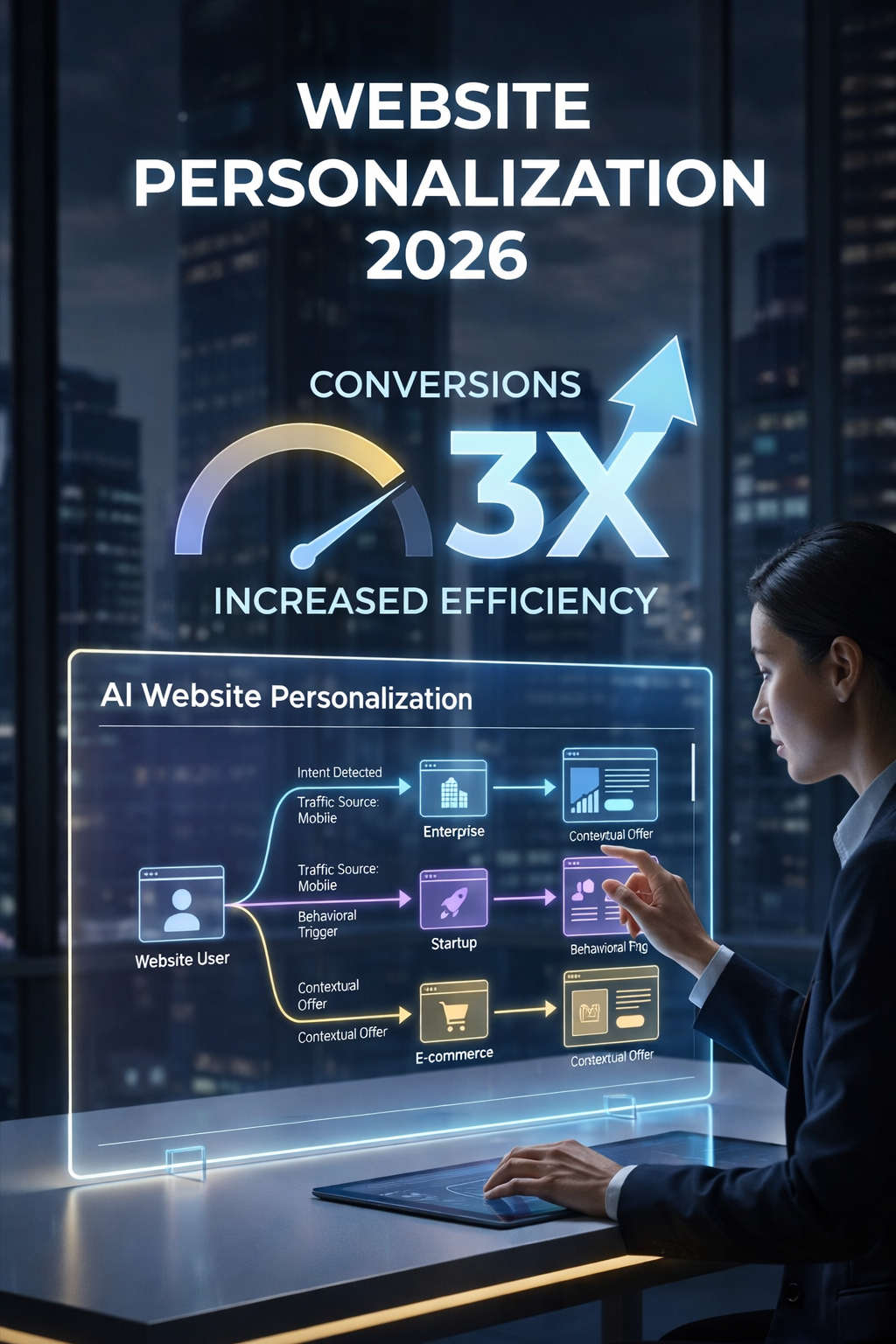
AI-Powered Personalization in 2026: How Smart Websites Are Increasing Conversions by 3X
In 2026, most businesses won't struggle with traffic.
They struggle with conversion efficiency.
Websites receive visitors from SEO, paid campaigns, referrals, and social media — yet conversion rates remain lower than expected.
The core issue is no longer visibility.
It’s intelligence.
Many websites still deliver the same content, same structure, and same call-to-action to every visitor — regardless of their intent, behavior, or stage in the buying journey.
That static approach is limiting growth.
AI-powered personalization is transforming how modern websites operate. Smart digital platforms now adapt to each visitor in real time — and businesses implementing this correctly are seeing conversion improvements of up to 3X (three times) compared to traditional static websites.
From Static Websites to Intelligent Web Architecture
A traditional website functions like a digital brochure:
- One homepage
- One service narrative
- One conversion path
- One universal user experience
An AI-powered website functions like a dynamic system.
It continuously evaluates:
- Traffic source
- On-site behavior
- Scroll depth
- Time spent
- Device type
- Location
- Repeat visits
- Engagement signals
Using AI-driven engines — including conversational systems built on models like ChatGPT by OpenAI — websites can interpret user intent and adjust messaging, structure, and offers instantly.
The result is a frictionless and highly contextual digital experience.
What 3X Conversions Means in Practical Terms
If a service website converts at:
- 2% before personalization
After implementing structured AI-based personalization, that rate can improve to:
- 6% or more
This does not require triple the traffic.
It requires better decision architecture.
In real business terms:
- More qualified inquiries
- Higher lead quality
- Shorter sales cycles
- Improved ROI on marketing spend
How This Applies to Development & IT Companies
For IT and web development companies, personalization is not about cosmetic changes. It is about strategic engineering experience.
At Findway Digital, we approach website development as performance architecture rather than static design.
Here’s how intelligent personalization changes outcomes:
Scenario: High-Intent Service Visitor
A user searches:
“Custom enterprise web application development”
Instead of landing on a generic homepage, an AI-personalized website can:
- Highlight enterprise case studies
- Surface technical capability sections
- Display scalability-focused messaging
- Offer direct consultation scheduling
- Trigger a contextual AI assistant conversation
Meanwhile, a startup founder arriving from a blog article might see:
- MVP development content
- Agile process explanations
- Cost-optimized engagement models
Same website.
Different strategic pathways.
This level of contextual differentiation significantly improves conversion probability.
E-Commerce & SaaS Implementation Scenario
For product-driven platforms, AI personalization enables:
- Dynamic product recommendations
- Behavioral pricing strategies
- Cart abandonment prediction
- Context-driven incentives
- Personalized onboarding flows
Instead of using aggressive popups, the system predicts drop-off probability and intervenes at the right moment.
This is where structured development expertise matters — personalization must be embedded within architecture, not layered on top as an afterthought.
Core Types of AI Personalization Used in 2026
1. Behavioral Personalization
Adjusts content based on:
- Pages viewed
- Click patterns
- Scroll engagement
- Interaction history
Example: Repeated service page visits trigger focused messaging and stronger CTAs.
2. Predictive Personalization
Uses AI modeling to forecast user intent:
- Identifying decision-ready visitors
- Adjusting pricing presentation
- Modifying messaging tone
This reduces hesitation and speeds up conversion cycles.
3. Contextual Personalization
Adapts based on:
- Location
- Device
- Traffic source
- Visit frequency
Mobile users receive optimized layouts.
Returning users see progress-based engagement prompts.
Corporate traffic sees enterprise positioning.
4. Conversational Personalization
Instead of static contact forms, intelligent assistants:
- Qualify leads
- Provide tailored solutions
- Route serious inquiries
- Integrate meeting scheduling
This minimizes manual qualification time for sales teams.
Does AI Personalization Impact SEO?
A frequent concern is whether dynamic content affects search rankings.
Search engines such as Google evaluate:
- Core Web Vitals
- Crawlability
- Page experience
- Engagement metrics
When implemented correctly within technical SEO standards, AI personalization can enhance:
- Dwell time
- Interaction depth
- Click-through behavior
- Conversion signals
The key is structured development — ensuring:
- Crawlable primary content
- Server-side rendering where required
- Performance optimization
- Transparent data handling
Personalization should enhance SEO performance, not conflict with it.
Why Personalization Works: The Strategic Advantage
AI-powered personalization succeeds because it:
- Reduces cognitive overload
- Delivers relevance instantly
- Aligns messaging with intent
- Minimizes friction in decision-making
- Increases trust through contextual understanding
It is not about adding complexity.
It is about removing unnecessary steps in the buyer journey.
Implementation Framework for Businesses
For companies evaluating AI-powered website upgrades, the structured roadmap includes:
1. Behavioral Data Infrastructure
- Event tracking
- Engagement mapping
- Conversion monitoring
2. Intelligent Segmentation
- High-intent traffic
- Returning visitors
- Service-specific behavior clusters
3. Strategic Personalization Layers
- Dynamic headlines
- Contextual CTAs
- Adaptive service presentation
4. AI-Driven Interaction Systems
- Conversational qualification
- Automated follow-ups
- Intelligent routing
At Findway Digital, personalization is integrated during the development phase — not added post-launch. This ensures performance, scalability, and compliance.
Common Implementation Mistakes
- Over-engineering personalization
- Ignoring site speed optimization
- Failing to test variations
- Implementing without clear KPIs
- Overlooking data privacy compliance
AI must simplify the journey — not complicate it.
The Future of Intelligent Websites Beyond 2026
Web platforms are evolving toward:
- Predictive decision interfaces
- Real-time dynamic landing pages
- Emotion-responsive UX
- Voice-assisted navigation
- Fully adaptive conversion funnels
Websites are no longer static digital assets.
They are becoming intelligent growth systems.
Final Perspective
AI-powered personalization in 2026 is not about adding automation for the sake of trend adoption.
It is about building intelligent digital infrastructure.
Smart websites:
- Adapt in real time
- Understand visitor intent
- Reduce friction
- Increase qualified leads
- Improve measurable ROI
In competitive IT and digital markets, traffic generation is only half the equation.
Frequently Asked Questions (FAQ)
What is AI-powered website personalization?
AI-powered website personalization is the use of artificial intelligence to dynamically customize website content, messaging, and offers based on a visitor’s behavior, intent, location, and interaction history in real time.
How does AI personalization increase website conversions?
AI personalization increases conversions by showing relevant content, targeted CTAs, and contextual offers to each visitor, reducing friction and guiding users toward faster decision-making.
Does AI-powered personalization affect SEO rankings?
When implemented correctly, AI personalization does not harm SEO. Search engines like Google prioritize user experience, engagement, and page performance — all of which personalization can improve.
Is AI personalization only for large enterprises?
No. In 2026, small and mid-sized businesses can implement AI personalization using scalable tools and structured development strategies without enterprise-level budgets.
What data is required for AI website personalization?
AI personalization typically uses behavioral data such as page visits, click patterns, time on site, device type, traffic source, and past interactions to customize the user experience.
How can an IT or web development company implement AI personalization?
Implementation involves integrating behavior tracking, intelligent segmentation, dynamic content rendering, AI-driven chat systems (such as tools powered by ChatGPT), and performance optimization within the website architecture.