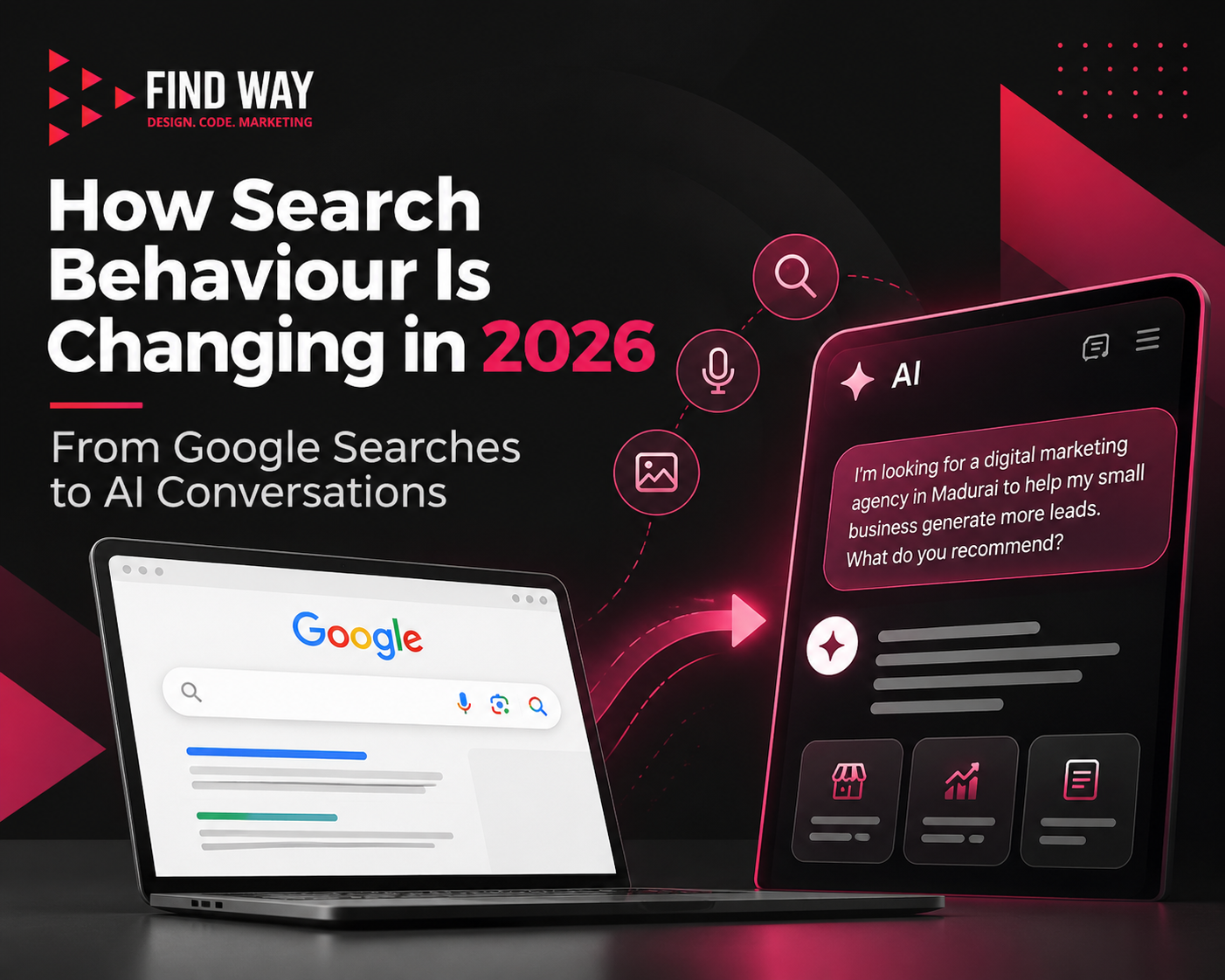
How Search Behaviour Is Changing in 2026: From Google Searches to AI Conversations
Not long ago, a business owner in Madurai searching for support might have typed “best digital marketing agency Madurai.” Now the same person is far more likely to write or I’m looking for a digital marketing agency in Madurai to help my small business generate more relevant leads. What factors should I consider before selecting a digital marketing agency?
That contrast captures the real change in search behaviour in 2026. People are not searching less. They are searching differently. They expect systems to grasp context, intent and follow-up questions rather than rely only on short keyword strings.
Search Is Becoming More Conversational
Users now prefer full questions over isolated keywords. Google’s reporting on AI Mode shows that the average query in this mode runs about three times longer than a typical traditional search. People add details, ask clarifying questions and treat the process as an ongoing exchange.
Conversational interfaces make this possible because users no longer have to invent the “right” keywords. They can simply describe their situation — location, goals, constraints — and let the system interpret it. What used to be a single search often becomes a short journey of related questions and refinements.
From Finding Links to Getting Answers
Classic search behaviour followed a clear sequence: enter keywords, scan a list of results, open multiple sites and compare the information yourself. In AI-assisted experiences the process often begins with a synthesized response. Users then refine their request, weigh options and visit selected sources when they need more depth or want to take action.
Websites still matter a great deal. Both search engines and AI systems depend on accurate, original information, clear business details and trustworthy content. The shift is that visibility now includes ranking in traditional results and also being useful enough to inform or appear in synthesized answers. People continue to click through when they need proof, local specifics or a way to make contact.
Search Is Becoming Multimodal
Typed text is no longer the only input. Voice queries, image searches and combinations of text with visuals are increasingly common. Google notes that more than one in six searches in the United States already involve voice or images, and image-based queries have grown quickly. A potential customer might photograph something, ask a spoken follow-up or blend a visual with a written question. Sites and content built only for typed keywords miss part of how people now look for information.
What This Means for Businesses
Simply targeting a list of keywords is no longer enough. Understanding search intent has become central. Content that answers genuine customer questions, shows real experience and demonstrates clear topical depth performs better across both classic and AI-powered search.
The practical foundations remain important: well-structured pages, logical internal links, accurate and consistent business information (especially for local visibility), sound technical SEO and reliable local signals. Practices sometimes called GEO or AEO build on traditional SEO. They help content become easier for AI systems to interpret and surface, without replacing the need for rankings, crawlability or a good user experience.
The New Search Journey
A common path today looks like this:
Question → AI or search answer → further exploration → comparison → website visit → enquiry or conversion.
Visibility across the entire sequence is more valuable than ranking for one isolated keyword. A business that appears only at the final click may miss earlier moments when influence is formed.
What Businesses Should Do in 2026
- Build content around the real questions customers ask, not only short keyword phrases.
- Place clear, direct answers near the top of relevant pages.
- Demonstrate genuine experience and expertise instead of generic statements.
- Keep website and business details accurate and consistent everywhere online.
- Continue strengthening traditional SEO while shaping content so it can also support AI-powered search experiences.
Conclusion
Search is moving from a primarily link-finding activity toward an environment where people ask, explore, compare and decide. Traditional SEO has not lost its value. The opportunity lies in understanding how audiences now search and how information is discovered, interpreted and presented.
Findway Digital supports businesses in improving digital visibility through SEO, content, websites and approaches that address both established search and newer AI-assisted experiences.
FAQs
Is traditional Google search still relevant in 2026?
Yes. Classic results and rankings continue to generate traffic and conversions. AI features expand the ways people search; they do not fully replace link-based discovery.
How do SEO, AEO and GEO differ?
SEO centres on discoverability and rankings in search results. AEO and GEO describe methods that make content clearer and more useful for answer-focused and generative AI experiences. They complement traditional SEO efforts instead of replacing them.
Do longer conversational queries require a completely new keyword list?
Concentrate on the problems and questions your customers actually express. Cover those topics thoroughly and clearly instead of chasing every long variation.
Will AI search eliminate website visits?
Some queries are resolved without a click. Users still visit sites for deeper information, verification, local details or to make contact. Authoritative original content remains necessary.