AI in Digital Marketing: How Businesses Are Using ChatGPT to Get More Leads in 2026
Introduction: The Rules of Lead Generation Have Changed
If your marketing playbook looks the same as it did two years ago, you're already behind.
In 2026, AI in digital marketing isn't an experiment anymore — it's the engine running behind every competitive campaign. Businesses that once spent weeks crafting email sequences or manually scoring leads are now doing it in minutes, with better results and fewer resources.
The shift isn't just about speed. It's about precision. ChatGPT for lead generation, AI-powered personalization, and predictive analytics are helping brands reach the right people at the right moment — before competitors even know the opportunity exists.
Here’s what it looks like when businesses actually apply these strategies in real-world marketing.
How ChatGPT Is Powering Lead Generation Right Now
Conversational AI That Qualifies Leads 24/7
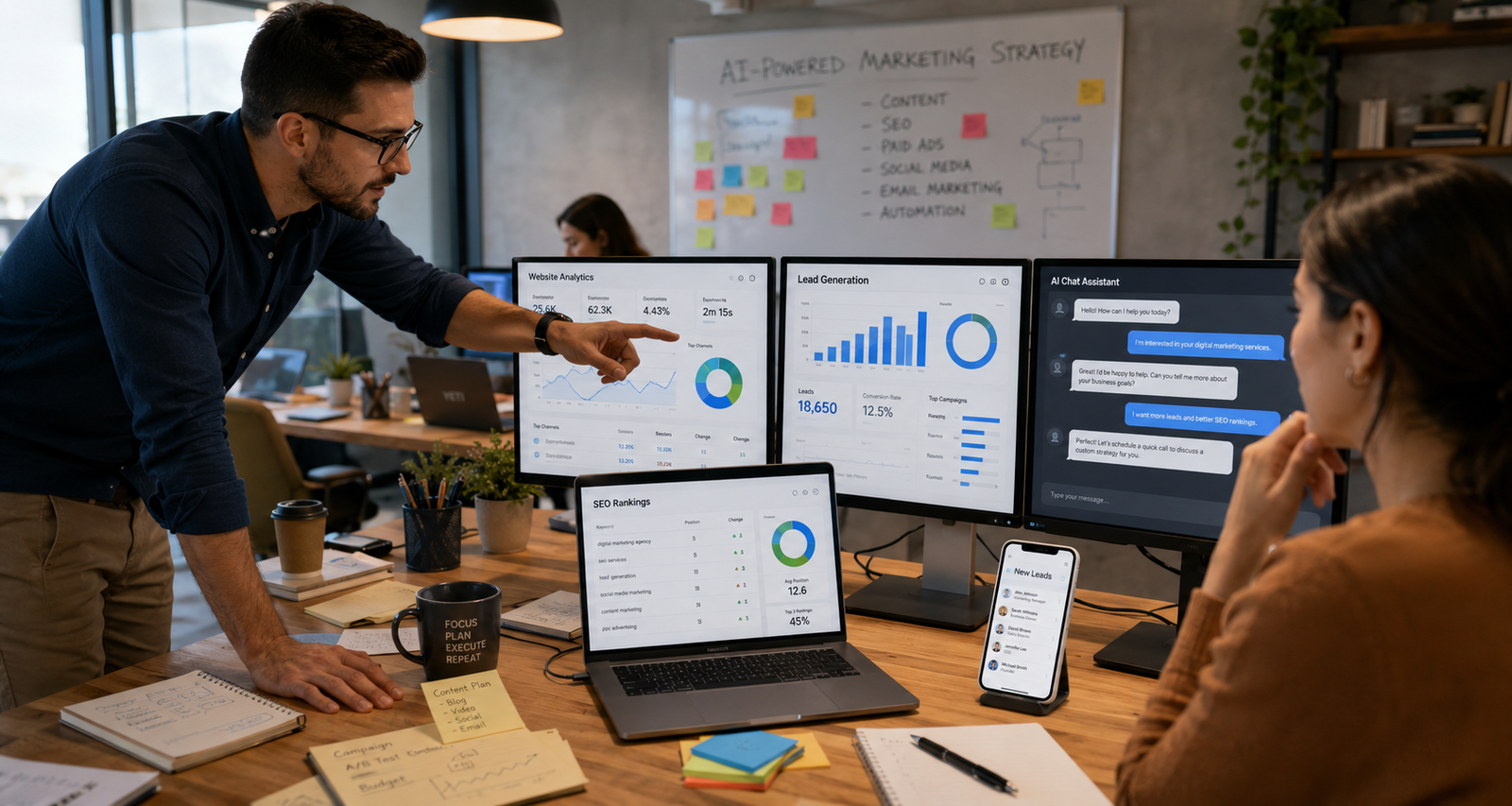
One of the most impactful applications of ChatGPT for lead generation is replacing static contact forms with intelligent, conversational flows. Instead of asking visitors to fill out a generic form, AI chatbots now ask contextual questions — budget, timeline, pain points — and build a rich lead profile in real time.
Prospects today expect instant answers in whichever channel they're already using, and conversational AI captures that intent immediately, qualifying it and moving serious buyers directly toward a booked meeting.
The result? Fewer dead-end form submissions, more sales-ready conversations.
Hyper-Personalized Outreach at Scale
Generic email blasts are dead. In 2026, AI tools analyze behavioral data, firmographic signals, and browsing history to automatically generate outreach that feels one-to-one — even when it's going to thousands of prospects.
AI makes hyperpersonalization possible at scale, with marketing platforms automatically sending different content versions based on the specific company, industry, and stage in the buyer journey.
AI Marketing Automation: Where the Real Efficiency Lives
Smarter Lead Scoring, Not Just Faster Lead Scoring
Traditional lead scoring relied on gut instinct and simple rules. AI flips that entirely. Predictive models now analyze conversion history, engagement patterns, and intent signals to rank prospects by likelihood to buy.
Research shows the chance of conversion drops by 80% if you wait longer than five minutes to follow up — and in 2026, AI agents are increasingly handling these time-critical tasks automatically, from instant alerts to personalized email sequences triggered by specific page visits.
Content Creation That Matches Search Intent
Over half of marketers now use AI tools to optimize content for search engines and email campaigns, while another 50% actively use AI assistance in content creation itself.
The smarter move isn't using AI to produce more content — it's using it to produce better-targeted content. Tools like ChatGPT help identify what questions buyers are actually asking, then structure answers that satisfy both human readers and AI-powered search engines like Google's AI Overviews and Perplexity.
Practical Business Examples
E-commerce Brand: A mid-sized online retailer integrated an AI chatbot on their product pages. Rather than losing potential customers who had questions about sizing or shipping, the chatbot responded immediately, captured their details, and guided them through an automated follow-up journey. Conversion on those chat interactions ran 3x higher than standard form fills.
B2B SaaS Company: A software company used ChatGPT to rewrite their blog content for GEO (Generative Engine Optimization) — structuring articles so they'd be cited in AI-generated answers. Within 90 days, branded mentions in ChatGPT and Google AI Overviews increased significantly, bringing in warmer inbound leads who already understood the product.
Marketing agencies like Findway Digital have been applying this AI-first approach for their clients — combining conversational lead capture with AI-driven content strategies to build pipelines that don't rely on ad spend alone. You can explore their approach at findwaydigital.com.
Digital Marketing Trends 2026: What's Actually Shaping Strategy
GEO Is the New SEO
In 2026, Generative Engine Optimization (GEO) is becoming critical — it's the practice of ensuring your content appears inside AI-generated answers, summaries, and overviews across platforms like ChatGPT, Perplexity, and Google.
ChatGPT alone is driving more than 87% of AI referral traffic, while Google's AI Overviews now appear in roughly 25% of all searches — up from 13% just a year ago. If your content isn't structured to be cited by these tools, you're invisible to a fast-growing segment of buyers.
First-Party Data Is Non-Negotiable
As third-party cookies fade and privacy regulations tighten, AI tools that work with first-party behavioral data are becoming the backbone of targeting strategies. Businesses collecting their own intent signals — through chatbots, quizzes, gated content — have a significant edge.
Common AI Marketing Mistakes Businesses Still Make in 2026
1. Using AI to produce volume, not value. More AI content without a clear strategy just adds noise. Quality and intent-alignment matter far more than output speed.
2. Ignoring the human layer. The most successful businesses in 2026 blend AI with human strategy, creativity, and oversight. Letting AI run completely unchecked leads to generic messaging that loses trust fast.
3. Optimizing only for traditional search. If you're still focused solely on Google blue links, you're chasing a shrinking audience. GEO and AEO optimization need to be part of the mix.
4. Skipping transparency. Research shows that 83% of consumers expect disclosure when AI is being used — making transparency a strategic priority, not just an ethical one.
FAQ
Q: Is ChatGPT actually useful for small business lead generation? Yes — especially for automating follow-ups, creating personalized email sequences, and building chatbot flows that qualify visitors without human involvement. Even lean teams can compete with enterprise-level lead nurturing.
Q: What's the difference between SEO and GEO? Traditional SEO mainly focuses on improving visibility in Google’s standard search rankings. GEO (Generative Engine Optimization) focuses on making your content structured and authoritative enough to be cited by AI tools like ChatGPT and Google AI Overviews. Both matter in 2026 — but GEO is the faster-growing priority.
Q: How do I start using AI marketing automation without a big budget? Start with one use case: either an AI chatbot on your site or AI-assisted email personalization. Prove ROI there, then expand. Tools like HubSpot's AI features or ChatGPT integrated with your CRM offer accessible entry points.
Conclusion: AI Tools for Businesses That Want to Grow Smarter
The businesses winning in 2026 aren't necessarily spending more — they're thinking more clearly about where AI creates real leverage. ChatGPT for lead generation, predictive scoring, GEO content strategies, and automated follow-ups are all working together to create pipelines that compound over time.
The key is strategy before software. Teams like Findway Digital understand that AI tools only perform as well as the thinking behind them — which is why blending automation with genuine expertise is still what separates results from noise.
If you're ready to put AI to work in your marketing, start by auditing where your lead generation breaks down. That's usually where the biggest gains are hiding.