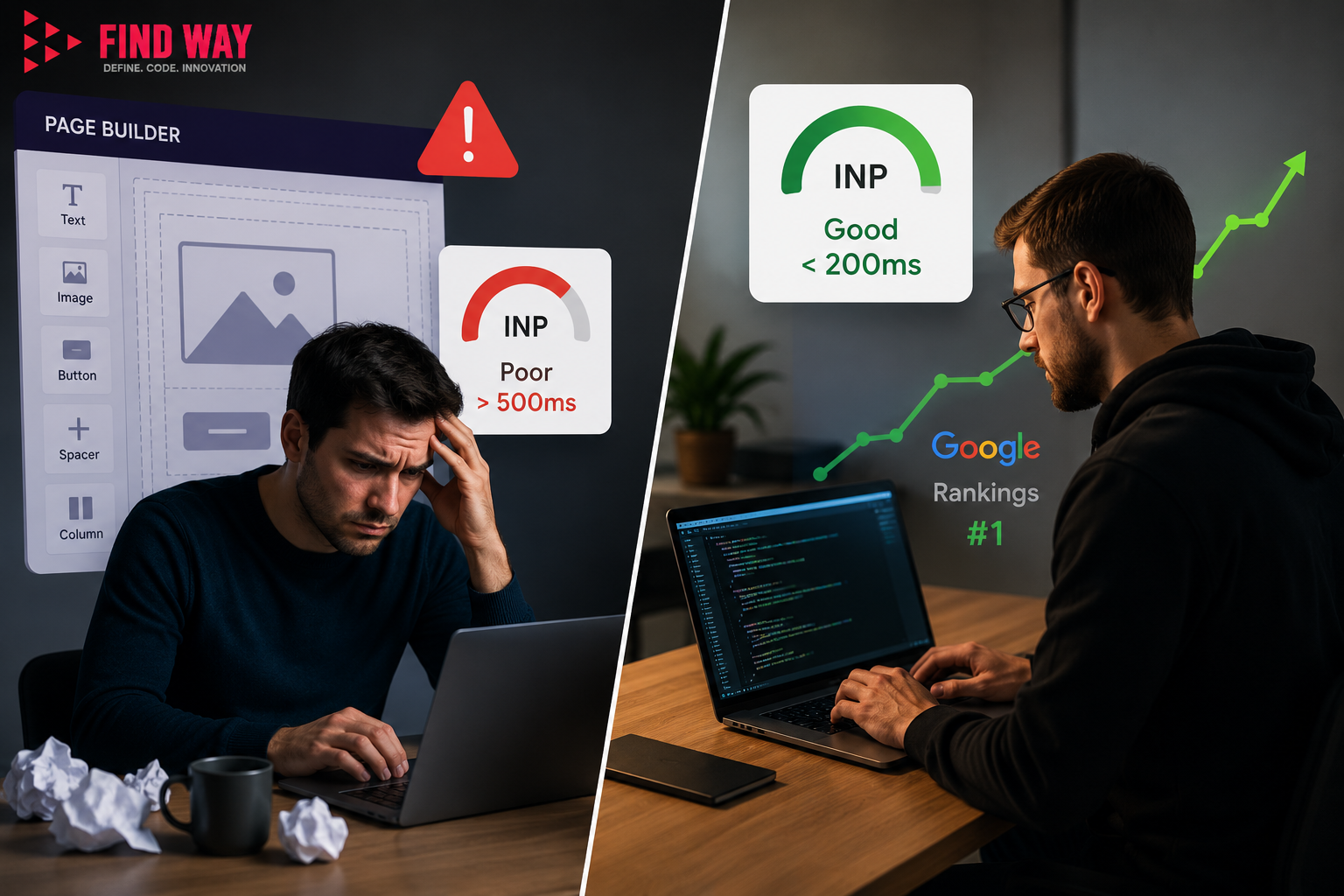
Why Page Builders Fail Google’s New INP Metric And How Custom Code Saves Your Rankings
In today’s competitive digital landscape, Core Web Vitals have become a critical ranking factor for Google Search. Among them, Interaction to Next Paint (INP) stands out as the newest and often most challenging metric. Many websites built with popular page builders struggle to achieve good INP scores, leading to poor user experiences and declining SEO rankings.
At Findway Digital, a leading web development company in Madurai, we specialize in high-performance websites that pass Google’s strict performance standards. In this comprehensive guide, we’ll explore why page builders often fail the INP metric and how switching to custom code can dramatically improve your INP optimization, boost page speed, and protect your search rankings.
What is Google’s INP Metric?
Interaction to Next Paint (INP) measures how quickly a page responds to user interactions like clicks, taps, or keyboard inputs throughout the entire user session. Unlike the older First Input Delay (FID), which only looked at the first interaction, INP evaluates all interactions and reports the worst one (with some outlier handling).
Google considers:
- Good: 200 milliseconds or less
- Needs Improvement: 200–500 milliseconds
- Poor: Over 500 milliseconds
INP became a Core Web Vitals in March 2024, replacing FID. It directly impacts page experience signals and SEO rankings. Sites with poor INP scores risk lower visibility in search results, higher bounce rates, and lost conversions.
Why Page Builders Struggle with INP
Popular page builders like Elementor, Divi, WPBakery, and others promise drag-and-drop convenience. However, they often generate significant JavaScript bloat, unused CSS, and complex DOM structures that block the main thread—the key culprit behind poor INP scores.
Common Issues with Page Builders:
- Heavy JavaScript Execution: Builders load extensive scripts for animations, widgets, and dynamic elements. Even on simple pages, this leads to long tasks that delay responses to user clicks.
- Render-Blocking Resources: Multiple CSS and JS files load synchronously, increasing processing time.
- Inefficient Code: Auto-generated code includes redundant styles and event listeners that aren’t optimized for real-world interactions.
- Plugin and Theme Bloat: Combined with numerous plugins, this creates a "kitchen sink" effect, where unused features still load and hurt performance.
Studies and real-world tests show that sites built with heavy page builders frequently score poorly on mobile INP, where resources are more limited. This is especially problematic for businesses in competitive niches relying on WordPress speed optimization for better rankings.
How Custom Code Improves INP Performance
Custom-coded websites, built with clean HTML, CSS, and vanilla JavaScript (or lightweight frameworks), offer precise control over every element. At Findway Digital, our team crafts tailored solutions that prioritize performance without sacrificing design or functionality.
Key Benefits of Custom Code:
- Minimal JavaScript Footprint: Only load scripts needed for specific interactions, reducing main-thread blocking.
- Optimized Event Handlers: Use efficient listeners, debouncing, and passive events for smoother responsiveness.
- Lean DOM Structure: Cleaner markup means faster parsing and painting.
- Better Resource Loading: Implement advanced techniques like code splitting, lazy loading, and critical CSS inline.
- Scalability: Custom solutions adapt easily to future updates without accumulating technical debt.
Businesses switching from page builders to custom development often see dramatic improvements in Core Web Vitals, including LCP, CLS, and INP, leading to higher Google rankings and better user engagement.
Real-World Impact on SEO and Business Growth
Poor INP doesn’t just frustrate users; it signals to Google that your site offers a subpar experience. In contrast, fast, responsive sites built with custom code rank higher, especially in mobile-first indexing.
Findway Digital has helped numerous clients in Madurai and beyond achieve excellent Core Web Vitals scores. Our approach combines modern web development best practices with SEO expertise, ensuring your site loads lightning-fast and responds instantly. Whether you need a complete redesign or performance audits, our website development services deliver measurable results.
How to Improve Your INP Score Today
Even if you use a page builder, targeted optimizations can still improve performance.
- Disable or defer non-essential scripts and plugins.
- Use performance plugins wisely (with caution).
- Optimize images and implement lazy loading.
- Minify CSS/JS and enable browser caching.
- Monitor with tools like Google PageSpeed Insights, Lighthouse, and real-user monitoring (RUM).
For the best long-term results, consider migrating to a custom-coded foundation. Our experts at Findway Digital provide seamless transitions with minimal downtime.
Conclusion
Google’s INP metric has raised the bar for web performance. While page builders offer speed in development, they often compromise on the user experience and SEO that matter most. Custom code provides the precision and efficiency needed to excel in INP optimization, Core Web Vitals, and overall page speed optimization.
At Findway Digital, we’re committed to building websites that not only look great but perform exceptionally well in Google’s eyes. Ready to future-proof your online presence and boost your rankings? Contact our team today for a free performance consultation.
Findway Digital – Your trusted web development partner in Madurai for high-performance digital solutions.
FAQs
1. What exactly is INP in Core Web Vitals?
INP (Interaction to Next Paint) is Google’s metric for measuring page responsiveness. It tracks the time between a user interaction and the next visual update, focusing on real-user experiences across the entire session. Good scores are under 200ms.
2. Do page builders like Elementor or Divi always hurt INP scores?
Not always, but they frequently do due to heavy code overhead. Proper optimization can mitigate issues, but custom code typically delivers superior and more consistent results for demanding sites.
3. How does poor INP affect SEO rankings?
Poor INP contributes to failing Core Web Vitals, which are part of Google’s page experience signals. This can lower your rankings compared to faster competitors, increase bounce rates, and reduce conversions.
4. Can I improve INP without switching from a page builder?
Yes—through heavy optimization like script deferral, image optimization, and plugin audits. However, for maximum gains and maintainability, custom development is often the better long-term investment.
5. How does Findway Digital help improve INP performance?
We provide full website audits, custom web development, WordPress speed optimization, Core Web Vitals fixes, and migrations from page builders to lightweight, high-performance code.
6. How long does it take to see improvements in rankings after INP optimization?
Improvements in user experience and field data can appear within weeks. Google typically incorporates performance signals into rankings over time, with noticeable gains in competitive searches often visible in 1–3 months.