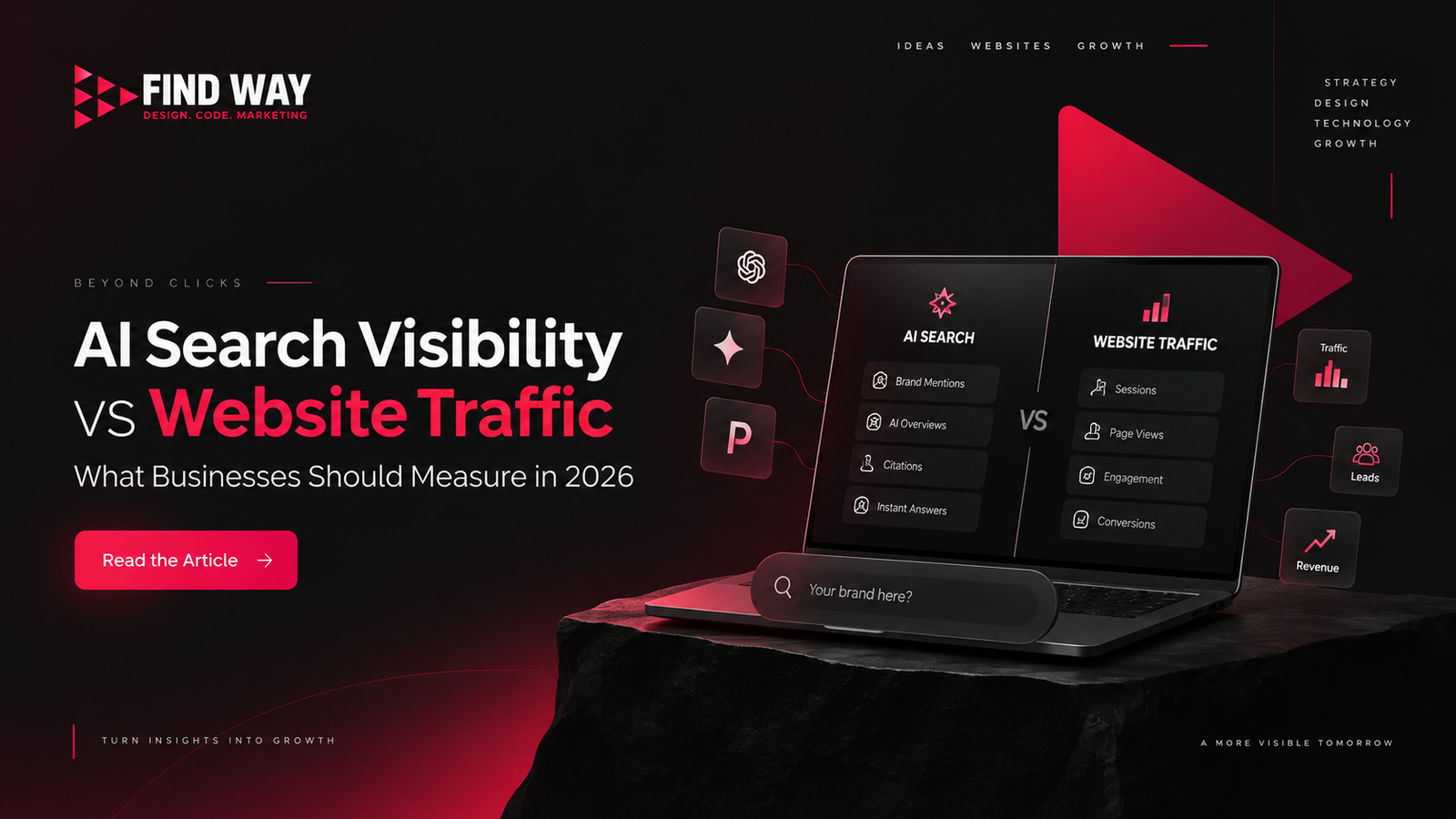
AI Search Visibility vs Website Traffic: What Businesses Should Measure in 2026
Your Google Analytics dashboard shows organic traffic climbing month over month. Campaigns are running. Content is publishing. Yet the phone isn't ringing any more than it was six months ago.
This disconnect is becoming common in 2026. Search behaviour has shifted: users increasingly receive answers directly inside search engines and AI assistants, sometimes without ever clicking through to a website. That raises a central question for business owners and marketing managers: is website traffic still the most important SEO metric in 2026?
The answer is nuanced. Traffic still matters, but it no longer tells the full story of how your brand is being discovered and considered.
Website Traffic Still Matters — But It Tells Only Part of the Story
Organic traffic remains a vital signal. It shows you how many people are visiting your site, which landing pages are performing, how users are engaging, and where conversion opportunities exist. Google Analytics continues to measure sessions, engaged sessions, and conversions from organic search, giving you a clear picture of on-site behaviour.
But traffic alone cannot reveal whether your brand is visible earlier in the journey. A page can be cited as a trusted source inside a Google AI Overview or mentioned by an AI assistant like ChatGPT or Perplexity without every user clicking through. In those cases, your brand gains awareness and credibility even if the session never registers in Analytics.
Clicks are one part of the customer journey, not the whole journey.
What Is AI Search Visibility?
AI search visibility refers to how often your business, brand, website, product, service, or content appears or is cited in AI-powered search experiences. These include Google AI Overviews, Google AI Mode, ChatGPT, Perplexity, and other generative search interfaces.
For example, someone might ask an AI assistant: "Best digital marketing agency in Madurai for SEO and website development." The response could list recommendations or cite sources without showing a traditional list of ten blue links. If your agency is mentioned or linked in that answer, you have AI search visibility—even if no click occurs.
This creates a new visibility layer that sits alongside traditional organic rankings.
AI Search Visibility vs Website Traffic
Different metrics answer different business questions. The table below outlines what each tells you and why it matters.
|
Metric |
What it tells you |
Why it matters |
|
Organic traffic |
Visits to your site from search |
Shows on-site engagement and conversion potential |
|
Search impressions |
How often your URL appears in search results |
Indicates raw visibility in traditional search |
|
Click-through rate (CTR) |
Percentage of impressions that become clicks |
Reflects how compelling your listing is |
|
AI search mentions |
Brand name appears in AI-generated answers |
Builds awareness and trust without a click |
|
AI citations |
Your URL is linked as a source in AI answers |
Signals authority and can drive qualified traffic |
|
Engagement |
Time on site, pages per session, return visits |
Shows whether visitors find your content useful |
|
Leads/conversions |
Form submissions, calls, purchases |
Ties search activity to business outcomes |
|
Revenue |
Sales attributed to organic and AI-driven paths |
The ultimate measure of search ROI |
No single metric is "best." Together, they form a complete picture.
What Should Businesses Measure in 2026?
A practical measurement framework organizes metrics into three levels:
1. Visibility
- Organic impressions and rankings
- AI Overview and AI Mode impressions (via Google Search Console's Generative AI report)
- Brand mentions and citations in AI search answers
- Coverage of relevant commercial and informational queries
2. Engagement
- Organic clicks and CTR
- Engaged sessions and key landing pages
- Returning visitors and time on site
3. Business Outcomes
- Leads, calls, and form submissions
- Qualified enquiries and sales
- Revenue and conversion rate
The goal is to connect visibility → engagement → conversions → revenue.
How SEO Is Changing in 2026
Traditional SEO has not disappeared. Instead, it now needs to support both human readers and AI systems. That means:
- Clear, useful content that answers real customer questions
- Strong technical foundations and crawlability
- Structured data and entity clarity where appropriate
- Authoritative, first-hand information
- Helpful answers to specific questions
- Strong internal linking and consistent local business information
GEO (Generative Engine Optimization) and AEO (Answer Engine Optimization) describe practices that make content easier for AI systems to retrieve, understand, and cite. There is no guaranteed formula for appearing in AI-generated answers, but high-quality, well-structured content improves your chances.forbes+1
A Practical Measurement Framework for Businesses
Here is a concise, actionable approach:
- Track traditional organic performance in Google Search Console and Analytics.
- Identify important commercial and informational queries for your business.
- Monitor whether your brand or content appears in relevant AI search experiences (AI Overviews, AI Mode, ChatGPT, Perplexity).
- Track citations, mentions, and referring pages where reliable data is available.
- Connect search activity to leads, enquiries, customers, and revenue.
- Review the data monthly instead of focusing on one metric.
Conclusion
Businesses should not choose between "AI visibility" and "website traffic." Instead, build a measurement system that connects search visibility → AI visibility → website engagement → leads → customers → revenue.
Modern SEO is an ongoing process, not a one-time ranking exercise. Want to understand whether your business is being discovered through traditional search and AI-powered search? Findway Digital can help you build a measurement strategy that connects search visibility with meaningful business results.