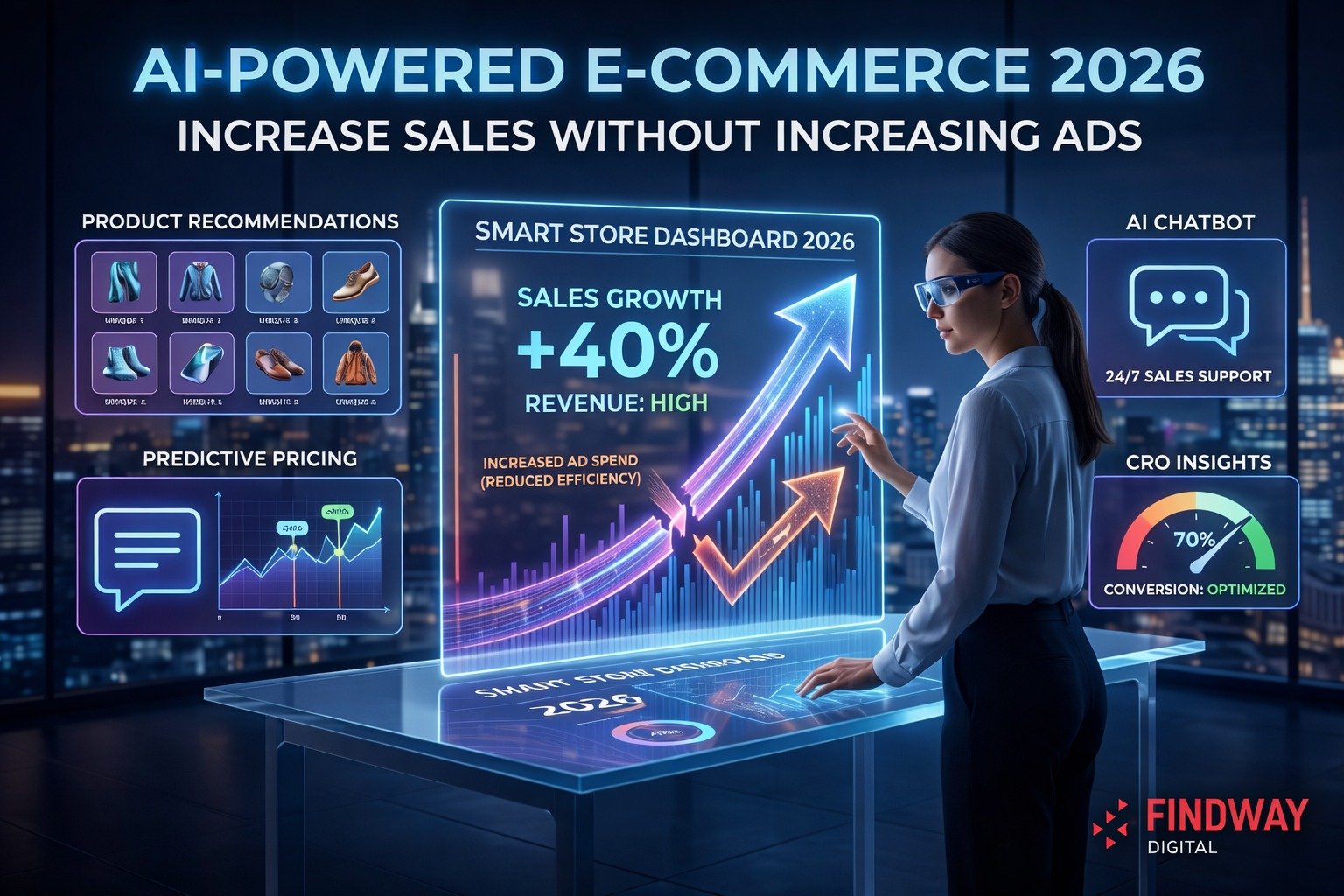
AI-Powered E-Commerce in 2026: How Smart Stores Are Increasing Sales Without Increasing Ad Spend
The cost of acquiring customers through paid advertising has been rising steadily in recent years. Many e-commerce businesses now face a common challenge—spending more on ads does not always translate into higher sales. As competition increases and customer acquisition costs climb, store owners are searching for smarter ways to grow revenue.
In 2026, the most successful e-commerce brands are shifting their strategy. Instead of relying entirely on paid traffic, they are using Artificial Intelligence(AI) to improve the performance of their stores. By focusing on personalization, automation, and data-driven decision making, AI-powered stores are increasing sales without increasing their advertising budgets.
Let’s explore how modern e-commerce businesses are using AI to unlock hidden revenue opportunities.
The Rising Cost of E-Commerce Advertising
For many online stores, paid ads used to be the primary growth strategy. Platforms like Google Ads, Facebook, and Instagram allowed businesses to reach large audiences quickly. However, as more brands enter the digital marketplace, advertising costs continue to increase.
Higher competition leads to higher cost-per-click and rising customer acquisition costs. For small and mid-sized e-commerce businesses, constantly increasing ad budgets is no longer a sustainable strategy.
Because of this, many store owners are shifting their focus from getting more traffic to maximizing the value of the traffic they already have. Instead of relying solely on advertising, they are improving how effectively their stores convert visitors into paying customers.
Why AI Is Becoming the Growth Engine of Modern E-Commerce
Artificial Intelligence is transforming how online stores operate. AI systems can analyze large amounts of customer data in real time, identifying patterns in browsing behavior, purchasing habits, and product preferences.
Using this data, AI enables e-commerce platforms to deliver highly personalized shopping experiences. Each visitor can see product recommendations, offers, and content tailored specifically to their interests.
This level of personalization was nearly impossible to achieve manually. With AI-powered tools, online stores can automatically optimize the shopping experience for every visitor, significantly improving conversion rates and customer satisfaction.
Personalized Product Recommendations That Increase Average Order Value
One of the most widely used AI features in e-commerce is personalized product recommendations.
Recommendation engines analyze customer behavior such as browsing history, previous purchases, and product interactions. Based on this information, the system suggests products that customers are most likely to buy.
These suggestions often appear in sections like:
- Customers also bought
- Recommended for you
- Frequently bought together
These recommendations make it easier for shoppers to discover relevant products and encourage them to add more items to their cart. As a result, stores can increase their average order value (AOV) without needing additional traffic.
For many successful e-commerce businesses, product recommendation engines contribute significantly to total sales.
Predictive Pricing: AI That Adjusts Prices for Maximum Profit
Pricing plays a critical role in whether customers decide to complete a purchase. Setting prices too high may discourage buyers, while prices that are too low can reduce profitability.
AI-powered predictive pricing tools analyze several factors, including:
- Customer demand
- Competitor pricing
- Market trends
- Inventory levels
- Seasonal patterns
Based on this data, AI can recommend optimal pricing strategies that balance competitiveness and profitability. Some systems can even adjust prices dynamically based on real-time market conditions.
This helps businesses remain competitive while maximizing revenue potential.
AI-Powered Upselling and Cross-Selling
Upselling and cross-selling are effective strategies for increasing revenue, and AI makes them even more powerful.
Instead of displaying random product suggestions, AI identifies items that naturally complement what the customer is already viewing or purchasing. For example, someone buying a laptop may see recommendations for accessories like a mouse, a laptop bag, or external storage.
AI systems can also create dynamic product bundles, suggesting related products that customers frequently purchase together.
These automated upsell strategies help increase the value of each transaction without requiring businesses to attract new customers.
ChatGPT-Powered Chatbots: The 24/7 AI Sales Assistant
Customer support is another area where AI is transforming the e-commerce experience.
Many online stores now use AI chatbots powered by advanced conversational models such as ChatGPT. Unlike traditional scripted chatbots, these systems can understand natural language and respond intelligently to customer questions.
AI chatbots can help customers:
- Find suitable products
- Get instant answers to product questions
- Compare options
- Track orders
- Receive personalized suggestions
Because they operate 24/7, AI chatbots guide customers through the purchasing journey at any time, helping reduce friction and prevent lost sales.
AI-Driven Conversion Rate Optimization
Beyond recommendations and chatbots, AI is also transforming conversion rate optimization (CRO).
AI-powered analytics tools analyze how visitors interact with an online store, identifying patterns such as where users drop off during checkout or which pages generate the most engagement. These insights help businesses improve landing pages, product layouts, and checkout experiences.
For example, AI can personalize landing pages for different customer segments or improve product search results to make shopping easier and faster.
Many digital growth teams now focus on implementing these AI-driven strategies to improve store performance. For example, agencies like Findway Digital work with businesses to combine SEO strategies with AI-powered optimization techniques that increase conversions without relying solely on paid advertising.
The Future of AI Commerce: Self-Optimizing Online Stores
As AI technology continues to evolve, the future of e-commerce is moving toward fully autonomous smart stores.
In these systems, AI continuously analyzes store performance and automatically adjusts elements such as product recommendations, pricing strategies, and promotional offers. The store effectively learns from customer behavior and improves its performance over time.
This level of automation allows businesses to focus on strategy and growth while AI handles operational optimization.
Conclusion
E-commerce growth in 2026 is no longer just about attracting more visitors—it is about making every visitor count.
With technologies like personalized recommendations, predictive pricing, automated upselling, AI chatbots, and intelligent conversion optimization, online stores can significantly increase revenue without increasing their advertising budgets.
Businesses that adopt AI-driven commerce early will gain a strong competitive advantage in the rapidly evolving digital marketplace.
FAQ
1. How is AI used in e-commerce stores?
AI is used in e-commerce to automate and optimize various parts of the online shopping experience. It helps with personalized product recommendations, dynamic pricing, automated upselling, customer support chatbots, and conversion rate optimization. These AI-driven tools analyze customer behavior and data to improve sales performance and enhance the shopping experience.
2. Can AI increase e-commerce sales without increasing ad spend?
Yes. AI helps stores increase revenue by improving conversion rates and average order value. Features like smart product recommendations, predictive pricing, and automated upselling allow businesses to generate more sales from existing traffic instead of relying on additional paid advertising.
3. What are AI product recommendations in e-commerce?
AI product recommendations are systems that analyze customer behavior such as browsing history, past purchases, and product interactions. Based on this data, the system suggests products that customers are more likely to buy. This improves product discovery and increases the chances of additional purchases.
4. How do AI chatbots help online stores?
AI chatbots act as 24/7 virtual assistants that help customers find products, answer questions, and guide them through the buying process. Advanced chatbots powered by technologies like ChatGPT can provide personalized recommendations and support, reducing customer friction and improving conversions.
5. What is AI-driven conversion rate optimization in e-commerce?
AI-driven conversion rate optimization (CRO) uses machine learning and behavioral analytics to understand how customers interact with an online store. It identifies where users drop off in the purchase journey and suggests improvements such as personalized landing pages, smarter product search, and optimized checkout experiences.